Zurichsee Promenade — Quaibrücke to Tiefenbrunnen
Lake Zurich, Zurich, Switzerland
About this route
When to walk it
The promenade is pleasant in every month and is at its best from May to October. In winter, the föhn wind can raise the temperature by 10 °C in a few hours and the lake turns a hard, bright blue that is worth catching. Swimming in the lake is officially permitted at the designated baths from May to September.
Numbers are estimates for the pace named above; the ground decides the rest.
Sensory anchors
Five things this ground gives you to notice. Each script paragraph ends on one of them.
- Sight The lake is 3.4 km wide at this point and 88 m deep, and on a clear day the Alps stand up behind the far shore as a hard white line.
- Sound Swans, gulls and the tram bells two streets back. The lake itself makes almost no sound because there is very little tide or surf — the water laps rather than breaks.
- Touch The promenade is smooth concrete and stone; the railings are painted steel, cool even in August, and the mooring rings along them are worn shiny.
- Smell Clean cold water with almost no smell at all; the strongest scent on the route is the lime trees on the inland side of the promenade in June.
- Breath Flat promenade, long count: six paces in, eight out. The longer exhale matches the slow lap of the water.
Walking script
Choose a script
-
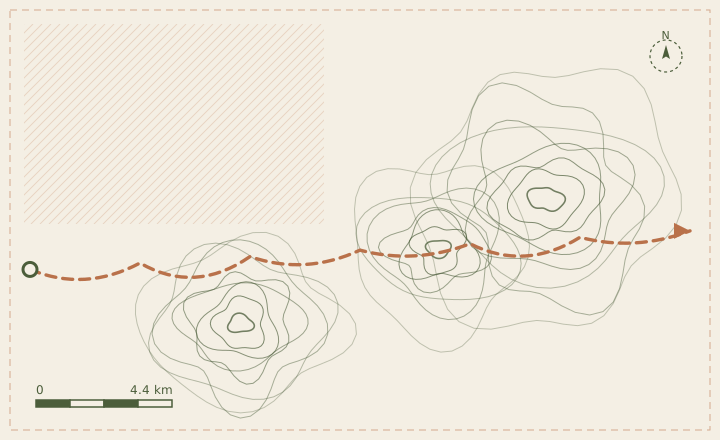
The Quaibrücke to Tiefenbrunnen promenade is about 4.4 km along the eastern shore of the lake, flat apart from a gentle rise at the Zürichhorn headland. Walk it from the bridge end, heading south-east, so that the water is on your right and the city on your left.
Sight · The lake is 3.4 km wide at this point and 88 m d… -
This is a working waterfront, not a park. There are moorings, a ferry dock, two boat clubs and a public bathing area along the route. The useful practice here is continuity: a walk that keeps its character through changing surroundings rather than one that only works in a quiet place.
Sound · Swans, gulls and the tram bells two streets back… -
The first kilometre runs past the boat clubs. Masts, rigging and hulls in various states of repair. Pick one object — a particular mast, or a particular moored boat — and walk until it is behind you, then pick the next. Choosing an object and walking to it is a way of making distance legible without counting it.
Touch · The promenade is smooth concrete and stone; the … -
At the Zürichhorn the promenade rises about 15 m onto a headland with a view back across the whole bay to the city. Stop at the top. From here you can see the full 4.4 km you are walking and, if the visibility is good, the Alps standing above the far end of the lake. Use this as the midpoint check: is your pace still the one you set out with?
Smell · Clean cold water with almost no smell at all; th… -
Past the headland there is a stretch of gravel beach used by swimmers from May onwards. In summer, walk this section slowly. People entering cold water do it in a particular way — fast, then very slow, then by degrees — and watching that sequence is more interesting than it sounds.
Breath · Flat promenade, long count: six paces in, eight … -
The last kilometre to Tiefenbrunnen passes the Chinese Garden and the lido. It is the most open part of the route and the wind off the lake is noticeable here even on calm days. Keep the pace and let the air be part of it.
Sight · The lake is 3.4 km wide at this point and 88 m d… -
Finish at the Tiefenbrunnen boat station. Lake Zurich is fed by the Linth and drains through the Limmat, and the whole body of water is replaced roughly every 440 days. Standing at the end of an hour-long walk and considering a 440-day turnover is a useful way to remember that the timescale you were using is not the only one available.
Sound · Swans, gulls and the tram bells two streets back…
Before you walk
General wellbeing information, not medical advice. Swimming is only permitted at the marked baths and lidos, and the lake shelves steeply within a few metres of the shore. The promenade is shared with cyclists and e-scooters; keep to the pedestrian side of the painted line.
Walking guidance on this site is general wellbeing information. It is not medical advice and it does not replace a clinician.