Lisbon Alfama — Escadinhas to Miradouro
Alfama, Lisbon, Portugal
About this route
When to walk it
Lisbon is walkable all year; April to June and September to October are best. July and August afternoons in Alfama are hot, steep and crowded simultaneously, and the stone stairs hold heat into the evening. January and February can be wet — the steps are slippery then and the trams are full.
Numbers are estimates for the pace named above; the ground decides the rest.
Sensory anchors
Five things this ground gives you to notice. Each script paragraph ends on one of them.
- Sight The Tagus two hundred metres below the miradouro, and the city's whole eastern slope of white walls and terracotta roofs falling towards it.
- Sound Fado practice from behind closed shutters in the late afternoon, tram bells, and the specific clatter of a hand cart on stone. Traffic is largely absent because most streets take no cars.
- Touch Basalt steps worn into shallow hollows in the middle where generations have landed; the stone is smooth and slick when wet or when it has been polished by dust.
- Smell Grilled sardines from the tiny restaurants from May onwards, plus laundry and, after rain, the specific smell of wet limestone.
- Breath Ninety-five metres of climb in 2.4 km is steep. Three paces in and five out on the flights; return to six and six on the flat stretches.
Walking script
Choose a script
-
Alfama is the oldest surviving quarter of Lisbon, built on the slope between the castle and the river. It survived the 1755 earthquake because it sits on bedrock rather than on the reclaimed ground that the rest of the lower city was rebuilt on. That geology is why the streets are still medieval and why they are all stairs.
Sight · The Tagus two hundred metres below the miradouro… -
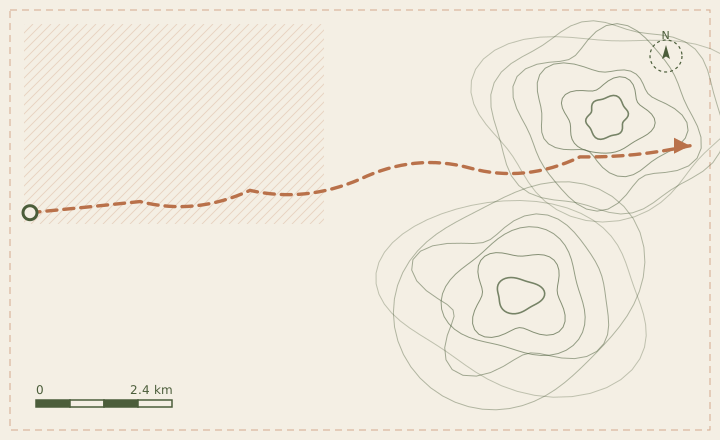
This route is 2.4 km with 95 m of climbing, and almost all of the climb is in three flights. That structure is useful: a walk with three distinct efforts is easier to practise than one continuous gradient. Treat each flight as a separate event with a beginning and an end.
Sound · Fado practice from behind closed shutters in the… -
Start at the cathedral and walk east into the quarter. Within 200 m the streets narrow and the traffic disappears. This is the transition that makes Alfama walkable: there are almost no through roads, so the noise level drops by more than half in a very short distance.
Touch · Basalt steps worn into shallow hollows in the mi… -
The first flight of stairs climbs towards the castle side. Use three paces in and five out — the long exhale is what keeps a steep flight from becoming a push. At the top of the flight, stop for ten breaths before continuing. Stopping at the top rather than in the middle is what allows you to keep the practice through the next one.
Smell · Grilled sardines from the tiny restaurants from … -
The middle section is a genuine flat stretch along a lane of small restaurants. In the afternoon this is where fado is being practised behind closed doors, badly and repeatedly. Walk it slowly. Hearing someone practise rather than perform is a reminder that the thing being done is a skill under construction, which applies equally to what you are doing.
Breath · Ninety-five metres of climb in 2.4 km is steep. … -
The final climb reaches the miradouro at the top of the quarter. From here the river is directly below and the whole eastern city is laid out. Stay for five minutes. There is a kiosk, and the view is the single most photographed thing in this part of Lisbon, which means it will be busy — that is part of the point of arriving on foot.
Sight · The Tagus two hundred metres below the miradouro… -
Come down by a different set of stairs rather than reversing the route. Alfama has more than thirty named escadinhas and they run at different angles. Descending a flight you have not climbed requires more attention than the one you have, which is a good way of keeping the last ten minutes of the walk from becoming automatic.
Sound · Fado practice from behind closed shutters in the…
Before you walk
General wellbeing information, not medical advice. Alfama's stairs are smooth basalt and genuinely slippery when wet; wear shoes with tread and use the handrails where they exist. Trams 12 and 28 run through the quarter on rails set into the street — they are quiet and give little warning at corners.
Walking guidance on this site is general wellbeing information. It is not medical advice and it does not replace a clinician.