Epping Forest Beech Trail — Hollow Ponds to Connaught Water
Epping Forest, Greater London / Essex, United Kingdom
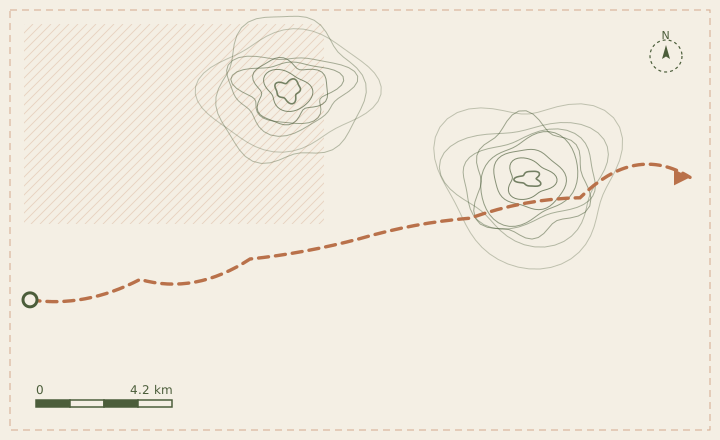
About this route
When to walk it
The beech mast falls from late September, and the leaf litter makes the path loudest and slipperiest in the first fortnight of November. Winter is the quietest season here — the trees are bare, sightlines open up, and the forest is 40 minutes from central London by Underground.
Numbers are estimates for the pace named above; the ground decides the rest.
Sensory anchors
Five things this ground gives you to notice. Each script paragraph ends on one of them.
- Sight Beech trunks that stay smooth and grey-green to the crown; on the pollarded veterans the trunk widens above head height into a fist of old growth.
- Sound Beech mast underfoot sounds like small dry gravel; oak litter a few metres away sounds like paper. You can hear the species change without looking down.
- Touch The bark of young beech is cool and almost slick, like unglazed porcelain. Older pollards are ridged and warm in sun.
- Smell In autumn, wet leaf mould and a faint vinegar note from decaying mast. In spring, the same ground smells of nothing much at all — clean and slightly dusty.
- Breath On the flat sections the count can be long — eight in, eight out. Save the short count for the two rises near Connaught Water.
Walking script
Choose a script
-
Enter from the Hollow Ponds car park and give the first five minutes to the transition. This is a managed forest with dog walkers, cyclists and a road audible from much of the northern edge, so the practice is not silence — it is choosing which layer of sound to stand in.
Sight · Beech trunks that stay smooth and grey-green to … -
The trail is 4.2 km with two gentle rises. Walk the first stretch at a medium pace so that your body is warm before you slow anything down. Slowing down cold makes the walk feel like a chore; slowing down after ten minutes of ordinary walking makes it feel like relief.
Sound · Beech mast underfoot sounds like small dry grave… -
Roughly 1.5 km in, the path runs between two lines of pollarded beeches that were cut for timber in the eighteenth century and never felled. Their trunks are hollow and often wider than your reach. Put a palm flat on one as you pass and leave it there for two steps. This is the touch anchor for the middle of the route.
Touch · The bark of young beech is cool and almost slick… -
Past the second rise the ground flattens and the trees open into grass. This is where most people speed up, because flat and open reads as easy. Resist it. Flat ground is the only place on this route where you can practise a long breath count without your legs interfering.
Smell · In autumn, wet leaf mould and a faint vinegar no… -
Connaught Water is the turning point. Walk one full lap of the water rather than stopping at the first bench. The far side is quieter, and the light coming back off the surface is the brightest thing on the whole route — useful if you have spent the last hour looking down at your feet.
Breath · On the flat sections the count can be long — eig… -
On the return, keep the same pace but change what you are monitoring. Instead of the breath, track the ground underfoot: beechnut, leaf, root, gravel, mud. Whenever you can name the surface correctly without looking, you have your attention in the right place.
Sight · Beech trunks that stay smooth and grey-green to … -
Leave five minutes for the last stretch back to the car park. Epping Forest is small and busy and it is easy to arrive back at the traffic still carrying the pace of the walk. Stand by the car until the breath is the one you started with.
Sound · Beech mast underfoot sounds like small dry grave…
Before you walk
General wellbeing information, not medical advice. Fallen beech mast is genuinely slick on the downslopes after rain, and the shared paths carry cyclists with limited sightlines. Keep left, keep a hand free, and do not use headphones on the sections shared with bikes.
Walking guidance on this site is general wellbeing information. It is not medical advice and it does not replace a clinician.