Paris Covered Passages — Palais-Royal to Passage Jouffroy
2nd and 9th arrondissements, Paris, France
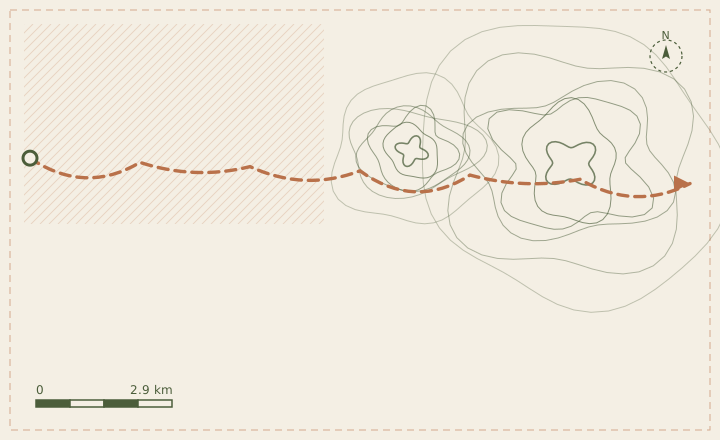
About this route
When to walk it
Covered passages are at their most useful in November and February, when it is raining and they are the only dry walking in central Paris. They are also, for the same reason, busiest on wet Saturday afternoons. Weekday mornings before eleven are the only time several of them are quiet.
Numbers are estimates for the pace named above; the ground decides the rest.
Sensory anchors
Five things this ground gives you to notice. Each script paragraph ends on one of them.
- Sight Glass roofs supported on iron and timber, running in straight lines for a hundred metres or more, with the floor some forty centimetres above the level of the modern street outside.
- Sound Footsteps on tile under a hard roof, mostly — no traffic, no weather. The passages have a specific, dry acoustic that makes even a single person walking sound like several.
- Touch Tile floors, some of them original and lipped where they have settled; iron columns and shopfronts with wooden frames rubbed smooth at hand height.
- Smell Old books and dust in the ones with antiquarian shops, and a persistent faint smell of cold iron and wet stone at the entrances where the passage meets the street.
- Breath Level and roofed, so a walk-and-stop rhythm works better than a count: six paces in and six out, stopping at each shop window that catches you.
Walking script
Choose a script
-
Paris has about twenty surviving covered passages, built mainly between 1798 and 1860 as dry, gas-lit shopping streets for people who did not want to walk in the mud. Most of them run roughly parallel to the grands boulevards between the 2nd and 9th arrondissements. This route strings four of them together with short street sections between.
Sight · Glass roofs supported on iron and timber, runnin… -
Start in the garden of the Palais-Royal, which is not a passage but sets the tone. It is a courtyard of arcades with a modern sculpture installation in the middle and lawyers' offices above. The covered walk around it is the ancestor of the passages: same iron, same glass, one generation earlier.
Sound · Footsteps on tile under a hard roof, mostly — no… -
Enter the Passage des Panoramas from the rue Saint-Marc. It is the oldest surviving passage, opened in 1800, and it is also the busiest and the least restored. Its glass roof was the first to be used as a public advertising surface in Paris. Walk its full 133 m length without stopping and notice how the light changes from the entrance to the middle.
Touch · Tile floors, some of them original and lipped wh… -
The halfway point of the route is the Passage Jouffroy, which opened in 1847 and was the first to be built with a floor of iron and glass and heated. Its floor is 40 cm above the street outside, a reminder that the street used to be a river of mud in winter. Stop at the crossing with the Passage Verdeau and stand still for twenty breaths.
Smell · Old books and dust in the ones with antiquarian … -
Walk the last stretch slowly and look up rather than into the windows. The upper storeys of the passages are where the ironwork is: fanlights, roof glazing bars, ventilation designed to draw warm air up and out. Almost nobody looks at this, and it is the reason the buildings survive.
Breath · Level and roofed, so a walk-and-stop rhythm work… -
Come out onto the boulevard and walk the 300 m between the last passage and the rue Vivienne on the street rather than immediately entering another. The contrast is the point of the route: the same city, forty centimetres lower, and a completely different acoustic.
Sight · Glass roofs supported on iron and timber, runnin… -
Finish with coffee in one of the passages' own cafés rather than outside. Sitting under the glass, at a table that has been in the same place for over a century, is the natural end of a walk whose entire subject is a type of interior that only exists in one city.
Sound · Footsteps on tile under a hard roof, mostly — no…
Before you walk
General wellbeing information, not medical advice. Several passages close at 8 pm and some are closed on Sundays; the Passage des Panoramas has steps at both ends and a route that splits, so check which exit you want before entering. Floors are original tile and are slippery when wet.
Walking guidance on this site is general wellbeing information. It is not medical advice and it does not replace a clinician.