Edinburgh Old Town — Closes and the Castle Descent
Old Town, Edinburgh, Scotland, United Kingdom
About this route
When to walk it
Avoid August, when the Festival takes the Old Town to several times its normal population and the Royal Mile is effectively a queue. May, June and September are the best months. Winter afternoons are dark by four, and the closes are unlit.
Numbers are estimates for the pace named above; the ground decides the rest.
Sensory anchors
Five things this ground gives you to notice. Each script paragraph ends on one of them.
- Sight Closes measuring barely a metre wide between six-storey tenements on both sides, opening without warning onto views of the Firth of Forth.
- Sound Bagpipes on the Royal Mile — usually one player, usually amplified, and audible from 300 m. Below it, the closes act as stone tubes and carry footsteps from the street above.
- Touch Setts and flagstones, worn into ridges; the closes are cobbled and are wet more often than the main streets because they get no sun.
- Smell Damp stone and, in the closes, a cold cellar smell that is strongest in the ones that still open onto the lower levels of the tenements.
- Breath The Royal Mile runs downhill to the east; the closes add short steep sections. Six and six on the Mile, three and five in any close that climbs.
Walking script
Choose a script
-
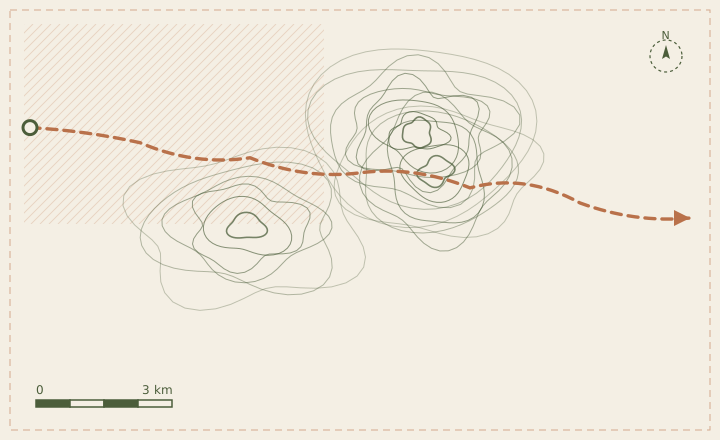
Edinburgh's Old Town sits on a ridge running from the castle down to Holyrood, with the Royal Mile along its spine and around seventy closes — narrow alleys — dropping off it on both sides. This route walks 3 km of the Mile but spends most of its time in the closes, which is where the walk is actually interesting.
Sight · Closes measuring barely a metre wide between six… -
Start at the castle esplanade. The Mile descends about 85 m over its length, so the walking direction matters: start high and walk down, and you will have the closes on either side to break up the gradient rather than a single continuous descent.
Sound · Bagpipes on the Royal Mile — usually one player,… -
The first close you take should be one of the longer ones, dropping towards the Cowgate. They are unlit, about a metre wide, and roofed by the storeys of the tenements on either side. Walking into one is a change of scale rather than a change of scene. Do it slowly, and let your eyes adjust rather than using a phone torch.
Touch · Setts and flagstones, worn into ridges; the clos… -
Each close has a different relationship to the ridge: some are stairs, some are ramps, some end in a wall. That unpredictability is what makes this a better walk than the Mile alone. Take a close on the north side, walk it to the end, come back up, and take the next one. Three closes in, you will have stopped expecting anything in particular, which is the correct state.
Smell · Damp stone and, in the closes, a cold cellar sme… -
The Mile itself is the connective tissue. Walk it at a steady medium pace and do not stop for the shops. It is a street that has been a processional route for six hundred years, and the crowd on it now is doing roughly what crowds have always done here.
Breath · The Royal Mile runs downhill to the east; the cl… -
The last section descends to Holyrood and the Scottish Parliament. This is where the ridge flattens out and the scale changes completely — from six-storey tenements to a low modern building and a park. Notice the change in the sound of your own footsteps as the ground changes from setts to paving.
Sight · Closes measuring barely a metre wide between six… -
Finish in Holyrood Park, looking back up at the ridge you have just walked down. From below, the Old Town reads as a single wall of buildings standing on a rock, which is not how it feels from inside. Two minutes of looking back at a place you have just been is the cheapest way there is to see it properly.
Sound · Bagpipes on the Royal Mile — usually one player,…
Before you walk
General wellbeing information, not medical advice. The closes are unlit, uneven and often wet, and several end in steps with no railings; do not walk them alone after dark. The Royal Mile and the closes are shared with delivery vehicles during the early morning.
Walking guidance on this site is general wellbeing information. It is not medical advice and it does not replace a clinician.