Copenhagen Harbour — Islands Brygge to Kalvebod Bølge
Copenhagen Harbour, Denmark
About this route
When to walk it
The harbour baths open from around 1 June to 31 August, with lifeguards on duty. The walk itself is good from March to November; in winter the light on the water at midday is low and the promenade is almost empty.
Numbers are estimates for the pace named above; the ground decides the rest.
Sensory anchors
Five things this ground gives you to notice. Each script paragraph ends on one of them.
- Sight Harbour water inside a city, blue-green and opaque; the Kalvebod Bølge bridge crosses it in a single swooping span with a wave-shaped profile.
- Sound Ropes against masts, the low idling of a harbour bus, and swimmers' voices carrying across open water, which distorts direction — you hear them before you can work out where they are.
- Touch Wooden boardwalk for most of the route, warm in the sun and slightly tacky with salt; the bathing platforms are unvarnished and get hot enough to need shoes in July.
- Smell Harbour water has a specific smell — salt, diesel and cold concrete — that is strongest at the bathing area and almost absent on the bridge.
- Breath Flat boardwalk allows a six-count; the bridge's arch takes a four-count up and a long eight-count down.
Walking script
Choose a script
-
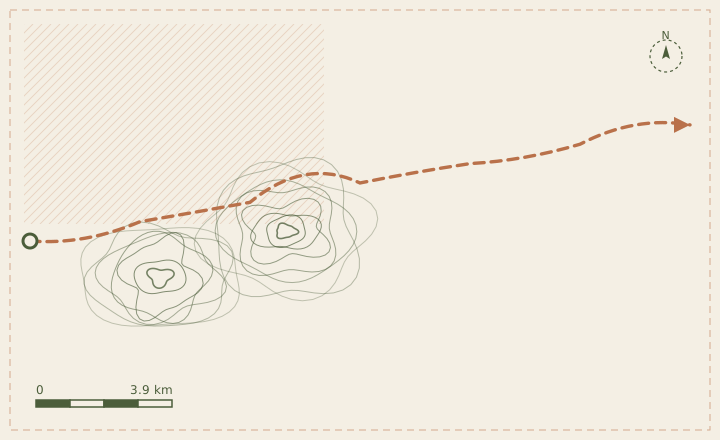
This route runs about 3.9 km along the inner harbour from the Islands Brygge baths to the Kalvebod Bølge bridge and back along the opposite quay. Copenhagen's harbour was cleaned to swimming standard in the 2000s, and the fact that you can swim in the middle of a working port is the most interesting thing about the walk.
Sight · Harbour water inside a city, blue-green and opaq… -
Start at the baths and walk south. The first section is a wide wooden boardwalk with moorings on one side. In summer the baths are full and loud. Walk past without stopping — the point of this route is the transition from a crowded urban waterfront to a quiet one, and you cannot feel that transition if you begin in the quiet part.
Sound · Ropes against masts, the low idling of a harbour… -
About 1.2 km in, the boardwalk passes under the Langebro bridge. The acoustics change completely for about thirty metres: enclosed, echoing, with the traffic overhead as a physical vibration rather than a sound. Walk it slowly and notice that the change is felt in the chest before it is heard.
Touch · Wooden boardwalk for most of the route, warm in … -
The middle stretch is open quay with nothing much on it. From here the water is wide and the far bank is a long low line of buildings. Set a steady pace and hold it for the whole stretch — this is the most disciplined kilometre on the route and the one where a walking practice earns its keep.
Smell · Harbour water has a specific smell — salt, diese… -
The Kalvebod Bølge bridge is the turning point. It is a footbridge with a wave-shaped deck and a single span of about 40 m. Cross it slowly, stop at the apex, and look back the way you came. You will be able to see the entire route, which is unusual and useful.
Breath · Flat boardwalk allows a six-count; the bridge's … -
Return along the far quay rather than the boardwalk. The far side is a working quay with barges and a ferry terminal, which is louder and rougher and a good contrast to the boardwalk you arrived on. Different surface, same water.
Sight · Harbour water inside a city, blue-green and opaq… -
Finish back at the baths. In summer, if you have any intention of swimming, do it at the end rather than the middle — cold water after an hour of walking is a different experience from cold water on a warm body, and the second is easier to enjoy.
Sound · Ropes against masts, the low idling of a harbour…
Before you walk
General wellbeing information, not medical advice. Harbour bathing is only safe inside the marked baths and only during the lifeguarded season; the harbour carries commercial traffic and the water elsewhere is deep with strong currents. Boardwalk edges over water are unguarded.
Walking guidance on this site is general wellbeing information. It is not medical advice and it does not replace a clinician.