Yakushima Moss Corridor — Arakawa Headwater Trail
Arakawa trailhead, Yakushima, Kagoshima, Japan
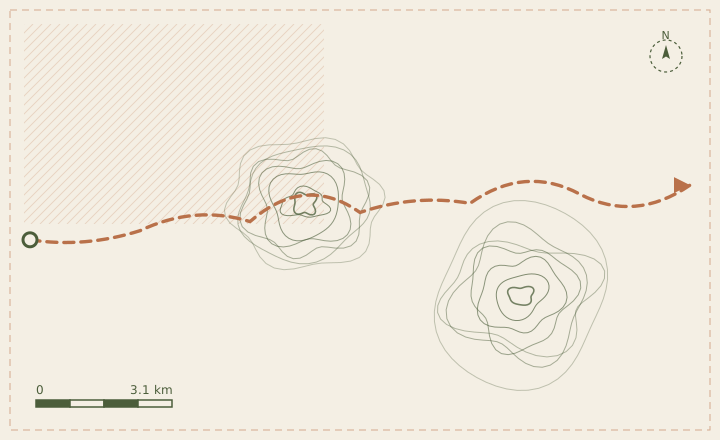
About this route
When to walk it
The moss is at its thickest from late May through June, during the island's heavy rain period, and holds through October. Yakushima rains on roughly 35 per cent of days in a year — a dry visit is the exception, not the rule. Slug activity after rain makes the stone sections genuinely slippery.
Numbers are estimates for the pace named above; the ground decides the rest.
Sensory anchors
Five things this ground gives you to notice. Each script paragraph ends on one of them.
- Sight Trunks wholly sheathed in moss so that the bark is invisible; the green is dark enough to read as grey at twenty metres, and only turns green when you are close.
- Sound Water is always audible, but never in the same place — the trail crosses and re-crosses the same stream, so the sound moves from left to right and back.
- Touch The moss on the raised roots is springy, like a firm mattress, and cold. Bare stone under the moss is not — that is where your foot goes if you trust the green without testing it.
- Smell Wet bark, leaf mould and a green, slightly sweet note from broken ferns; after a rain band passes, the whole trail smells like the inside of a greenhouse.
- Breath The climb forces a shorter cycle than you would choose: three steps in, three out, on the steep sections. Let it be short rather than deep.
Walking script
Choose a script
-
Start early. The trailhead fills by eight in the morning, and the first kilometre is shared with everyone who arrived on the same bus. Walk that stretch at whatever pace the crowd allows and save the practice for the second half, where the groups thin out.
Sight · Trunks wholly sheathed in moss so that the bark … -
The route here is short but not flat: 3.1 km with 180 m of gain, most of it in two stepped sections. Treat each step of the stone stairways as a complete action — place the foot, feel the weight transfer, then look up. Breaking the climb into single steps does more for the breathing than any attempt to control it.
Sound · Water is always audible, but never in the same p… -
Once you are past the second stairway, the moss starts covering the handrails. Put a hand on it. The rail is cold and slightly damp even under a clear sky, and holding it for three or four steps changes the walk from something you watch into something you are in contact with.
Touch · The moss on the raised roots is springy, like a … -
The stream crossings are the natural pauses. There are seven of them, and each one asks the same question: where is the driest stone? Answer it slowly. Crossing badly is the only real hazard on this trail, and the two seconds you save are not worth a soaked boot at the far end of the island.
Smell · Wet bark, leaf mould and a green, slightly sweet… -
Somewhere in the middle third the canopy is so complete that the light has no direction. Do not look for a view — there is none, and that is the point of this route. Instead, pick a single trunk ten metres ahead and walk until it is beside you, then pick another. The corridor becomes a sequence of arrivals rather than a distance.
Breath · The climb forces a shorter cycle than you would … -
On the return, the downhill asks for a different attention. Descending, the eyes want to run ahead of the feet. Give them a job: read the roots before you reach them, and count how many you step over. The count keeps the attention where the balance is.
Sight · Trunks wholly sheathed in moss so that the bark … -
Finish at the trailhead shelter rather than at the car. Sit for five minutes with the rain jacket still on. Yakushima's moss exists because the island never really dries out, and the walk is easier to remember if you let the last of the wet stay on you for a while.
Sound · Water is always audible, but never in the same p…
Before you walk
General wellbeing information, not medical advice. Yakushima's trails are wet for most of the year: wear boots with real tread, carry rain shells top and bottom, and turn back if a crossing is running above knee height. Mobile coverage is patchy past the trailhead — file a walking plan with the trailhead box.
Walking guidance on this site is general wellbeing information. It is not medical advice and it does not replace a clinician.