Shinjuku Gyoen Lawn Loop
Shinjuku Gyoen, Shinjuku, Tokyo, Japan
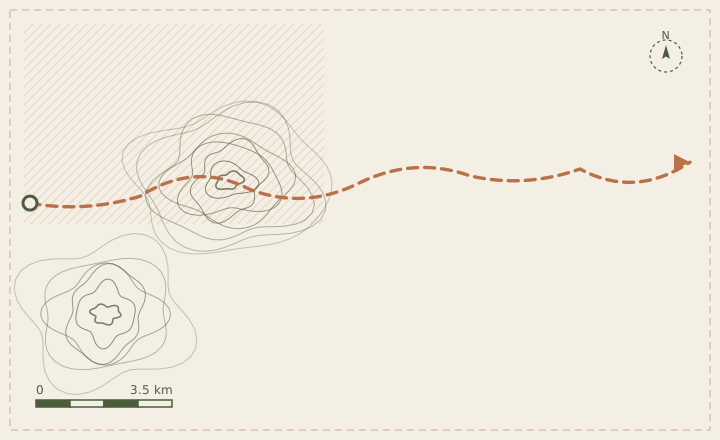
About this route
When to walk it
The garden is open all year and charges a small entry fee; it closes on Mondays. The two best windows are the cherry weeks in late March and the maple weeks in the second half of November. Summer mornings before nine are the only comfortable option in July and August.
Numbers are estimates for the pace named above; the ground decides the rest.
Sensory anchors
Five things this ground gives you to notice. Each script paragraph ends on one of them.
- Sight Lawns that are mown to a uniform height and kept clear of everything; behind them, three garden traditions — French formal, English landscape, Japanese traditional — meeting at hard edges.
- Sound Open lawn has almost no acoustic reflection, so sound drops off quickly. The Tokyo traffic that is loud at the gate is gone within 200 m of the entrance.
- Touch The loop's main path is fine gravel over a rolled base — firm and fast. The lawn edges are soft but you are asked to stay off the grass in the traditional garden.
- Smell Cut grass from April to October, and in the greenhouse area a heavy tropical humidity that is worth walking through once for the change in air.
- Breath The loop is flat and the paths wide. Use six paces in, six out, and shorten to four where the path narrows between the ponds.
Walking script
Choose a script
-
Shinjuku Gyoen is 58 hectares in the middle of the densest part of Tokyo, and the loop around the lawns and ponds is about 3.5 km. Start at the Shinjuku gate and take the loop clockwise; the first stretch along the lawn is the widest path in the garden and the best place to set a pace.
Sight · Lawns that are mown to a uniform height and kept… -
The garden was a feudal residence, then an imperial garden, then a public one from 1949. Its three styles are laid side by side rather than blended, and the edges between them are abrupt. Walk the transitions rather than the sections: the ten paces where English lawn becomes French parterre are more interesting than either.
Sound · Open lawn has almost no acoustic reflection, so … -
The middle kilometre passes the ponds. This is the lowest and most enclosed part of the loop, and the place where the garden stops feeling like a lawn and starts feeling like a garden. Slow down here by a third and let the pace change be deliberate rather than accidental.
Touch · The loop's main path is fine gravel over a rolle… -
There is a bridge between the upper and lower ponds with a view in both directions. Stand on it for a count of twenty breaths facing one way, then turn and do twenty more facing the other. Orientation changes what you notice more than duration does.
Smell · Cut grass from April to October, and in the gree… -
The greenhouse is on the north side of the loop and is worth ten minutes. The air inside is 8-10 °C warmer and far more humid than outside; walking through it slowly and coming out again is a reminder that most of what you feel on a walk is the air, not the view.
Breath · The loop is flat and the paths wide. Use six pac… -
The last kilometre runs along the boundary wall on the east side. Traffic is audible again through the trees. Do not speed up to match it. The garden's whole design is a buffer between the city and the person in it, and the buffer works better at a slow pace.
Sight · Lawns that are mown to a uniform height and kept… -
Leave by the Sendagaya gate rather than the one you entered by. Exiting through a different gate is a small way of keeping the walk from becoming a circuit you close, and Shinjuku Gyoen has three gates within a ten-minute walk of each other.
Sound · Open lawn has almost no acoustic reflection, so …
Before you walk
General wellbeing information, not medical advice. The garden closes at 6 pm in summer and 4 pm from October, with last entry 30 minutes before; it is shut on Mondays. Staying off the lawn in the traditional garden is a condition of entry, not a suggestion.
Walking guidance on this site is general wellbeing information. It is not medical advice and it does not replace a clinician.