Madrid Río — Senda del Río
Madrid Río, Madrid, Spain
About this route
When to walk it
The park opened in 2011 after the M-30 was put into tunnels, and it has been planted with species chosen for Madrid's climate, so it stays green through August. Walk before 9 am or after 8 pm from June to September; the riverside path has more shade than the rest of the park.
Numbers are estimates for the pace named above; the ground decides the rest.
Sensory anchors
Five things this ground gives you to notice. Each script paragraph ends on one of them.
- Sight A river running in a formal channel with weirs every few hundred metres, and eleven new bridges across it, each by a different engineer; the Arganzuela bridge is a 400 m spiral of steel.
- Sound Water over the weirs is the constant, with the low hum of the tunnelled M-30 audible where the vent shafts come up beside the path.
- Touch The Senda del Río is fine compacted gravel, rolled and drained; the handrails on the weir footbridges get hot enough in July to be unpleasant to grip.
- Smell The river itself has almost no smell — it is a managed channel — but the planted edges smell strongly of poplar and oleander in May and June.
- Breath Flat, so six in and six out; the approach ramps to the Arganzuela bridge take a four-count.
Walking script
Choose a script
-
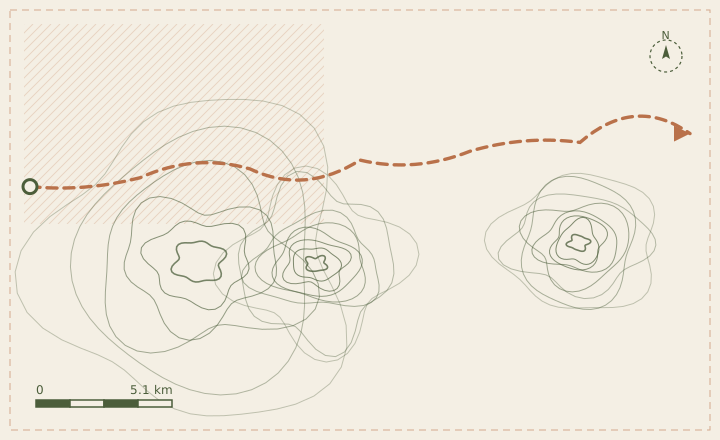
Madrid Río is a 10 km linear park built on land freed when the M-30 ring road was moved into tunnels between 2003 and 2011. The Senda del Río is the path that follows the water. Walk 5.1 km of it from the Puente de Toledo towards the Arganzuela bridge and back.
Sight · A river running in a formal channel with weirs e… -
The first thing to understand about this route is that it is new. The trees are between ten and twenty years old, the gravel is uniform, and the whole thing has the slightly provisional look of a place that is still settling. Walking a new landscape is different from walking an old one: nothing here has had time to become inevitable.
Sound · Water over the weirs is the constant, with the l… -
Start at the Puente de Toledo, which is the one old thing on the route — an eighteenth-century baroque bridge that was left in place when the modern ones were built. Cross it, look at it from the far side, and then start walking. Beginning with the one historic object makes everything after it read as modern.
Touch · The Senda del Río is fine compacted gravel, roll… -
The path passes a weir roughly every 400 m. Each one makes a low, continuous roar that varies with the flow. Stand at the third weir for twenty breaths with your eyes closed. Water noise is broadband and unstructured, which makes it good at masking other sound and poor at providing a rhythm — the opposite of what most people expect from a walking soundtrack.
Smell · The river itself has almost no smell — it is a m… -
Halfway along, the path passes under the M-30 ventilation shafts. This is the least pleasant 200 m on the route: a hum you can feel in your teeth and no view. Walk it at a normal pace and do not attempt anything else with your attention. There is no benefit in pretending a dull stretch is interesting.
Breath · Flat, so six in and six out; the approach ramps … -
The Arganzuela bridge is the endpoint. It is a 400 m spiral that rises about 20 m, wrapped in steel mesh, and it is the only place on the route where you are above the level of the traffic. Walk up it and stand at the top for a full minute before coming down.
Sight · A river running in a formal channel with weirs e… -
Finish on the far bank where the park narrows towards the Matadero. From there the river runs straight for about a kilometre and you can see the whole of it. Madrid Río's greatest quality is that it exists at all — a motorway was put underground and given back as a park, and walking it end to end is a way of taking that seriously.
Sound · Water over the weirs is the constant, with the l…
Before you walk
General wellbeing information, not medical advice. The river is a managed channel with weirs and is not a swimming watercourse; entry is prohibited and the banks are steep-sided. The park is busy with cyclists in the evening — the Senda del Río is the pedestrian path, not the cycle route.
Walking guidance on this site is general wellbeing information. It is not medical advice and it does not replace a clinician.