Nikko Cedar Avenue — Imaichi Segment
Nikko Kaido, Imaichi, Tochigi, Japan
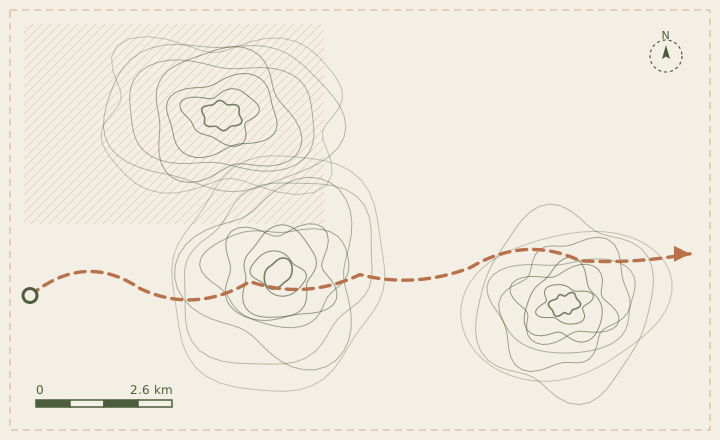
About this route
When to walk it
Best from late April to early June, when new needles are still pale, and again in the first half of November. Mid-August is humid enough that the shade stops feeling like relief; the surface stays dry even after heavy rain because the canopy intercepts most of it.
Numbers are estimates for the pace named above; the ground decides the rest.
Sensory anchors
Five things this ground gives you to notice. Each script paragraph ends on one of them.
- Sight Cedar trunks the width of a doorway, bark split into vertical plates; the canopy closes about 25 m overhead, so the road runs in green shade even at noon.
- Sound Wind in the crowns arrives roughly a second before you feel it at ground level — a long shhhhh that travels from far to near and then stops.
- Touch The shoulder is packed earth and needle litter; it gives about a centimetre underfoot, noticeably softer than the asphalt strip you are walking beside.
- Smell Dry cedar resin over wet stone. After rain the same smell doubles and sits at the back of the throat for the first hundred metres.
- Breath Six paces in, six paces out. The spacing of the trunks supplies the count without you having to look down at a watch.
Walking script
Choose a script
-
Park at the Imaichi end and walk in rather than starting under the densest trees. The first three minutes are for the ordinary business of arriving: feel the pack settle, let your hands hang, and pick a pace slightly slower than the one you use on a pavement. You are not trying to walk well. You are trying to walk at a speed where you can still notice things.
Sight · Cedar trunks the width of a doorway, bark split … -
Notice the moment the sound of the road behind you drops away. There is no sign for it. One step the traffic is at your back, and a dozen steps later it is behind a wall of trunks, and the change is not gradual. Stand still for ten breaths when you catch it, then walk on.
Sound · Wind in the crowns arrives roughly a second befo… -
Once the road noise is gone, the ground becomes the clock. Cedar litter is quiet; packed earth is quieter; the gravel patches between them announce every footfall. Walk twenty paces on litter, twenty on gravel, twenty on earth, and let each surface tell you how heavy your step is. Most people find the gravel segment shortens their stride by itself.
Touch · The shoulder is packed earth and needle litter; … -
Now bring the breath in. On a straight avenue you have the luxury of a fixed count: six paces in, six paces out. If six is uncomfortable, use four, and if you lose the count — you will — do not restart from one. Just pick it up at whatever number you notice next.
Smell · Dry cedar resin over wet stone. After rain the s… -
About a third of the way in there is a stretch where the canopy opens for 30 m and daylight reaches the road. Do not speed up through it. This is the only place on the segment where you can see the trees whole, root to crown, and the change in light is worth thirty seconds of standing.
Breath · Six paces in, six paces out. The spacing of the … -
On the way back, take the far shoulder if it is dry. Walking the same avenue in the opposite direction is not the same walk: the light is behind you now, the trunk shadows point the other way, and the second half of the outward journey's sounds arrive in reverse order.
Sight · Cedar trunks the width of a doorway, bark split … -
Finish with two minutes of standing still before you get in the car. The point of the return leg is not to have covered the route again. It is to arrive at the car with the pacing still in your legs, so that the first thing you do after the walk is not to hurry.
Sound · Wind in the crowns arrives roughly a second befo…
Before you walk
General wellbeing information, not medical advice. The avenue is an active road: walk on the shoulder facing traffic where there is no footway, and cross only where you can see both directions for at least 200 m. Tell someone your turnaround point before you start.
Walking guidance on this site is general wellbeing information. It is not medical advice and it does not replace a clinician.