Central Park Ramble — Woodland Tangle
The Ramble, Central Park, New York City, United States
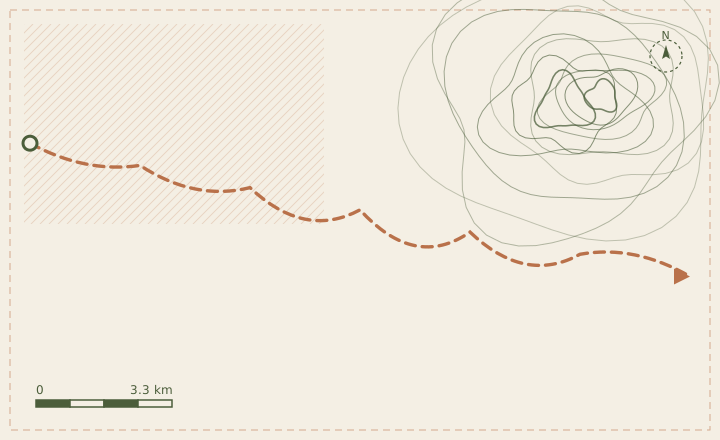
About this route
When to walk it
The Ramble is at its best in the first three weeks of May, when migration brings more than 20 warbler species through in a single morning, and in late October. In August the canopy traps heat and the tangle is humid and mosquito-heavy.
Numbers are estimates for the pace named above; the ground decides the rest.
Sensory anchors
Five things this ground gives you to notice. Each script paragraph ends on one of them.
- Sight Paths that split and rejoin every forty metres, none of them straight; you can see perhaps 25 m ahead and no further, in the middle of Manhattan.
- Sound The city is audible everywhere as a low continuous wash, punctuated by specific sounds: a siren, a helicopter, a tour group. Birds sit above that layer, not instead of it.
- Touch The Ramble paths are dirt and gravel, often muddy at the low points; the wooden railings along the stream are worn smooth and warm up in the sun.
- Smell Sweetgum and wet soil after rain; in May, the sharp green smell of new growth. There is also, always, a faint diesel note from the drives.
- Breath The tangle is short and irregular, so the count breaks often. Use four in and six out and expect to restart it many times.
Walking script
Choose a script
-
The Ramble is 15 hectares of deliberately tangled woodland inside Central Park, with about 3 km of paths, none of which run in a straight line. Frederick Law Olmsted designed it in 1857 to be disorienting on purpose. Walking it as a practice means accepting that you will not know exactly where you are, and that this is not a problem to solve.
Sight · Paths that split and rejoin every forty metres, … -
Enter from the 79th Street transverse and head for the stream. The first few minutes are the noisiest: the transverse carries four lanes of traffic and the sound follows you in for a while. Let it. There is no gate where the city stops.
Sound · The city is audible everywhere as a low continuo… -
Within ten minutes the paths begin to branch. Take the smaller path each time. Olmsted's paths were built so that visitors would lose the sense of a destination and start looking at what was beside them. Choosing the narrower path is a way of agreeing with the design.
Touch · The Ramble paths are dirt and gravel, often mudd… -
At the stream crossing, stop on the wooden footbridge for twenty breaths. This is the lowest point of the Ramble and the quietest, because the ground falls away from the drives. Water here is artificial and shallow, maintained by a pump, and knowing that does not make the sound less useful.
Smell · Sweetgum and wet soil after rain; in May, the sh… -
The middle section climbs gently onto the tangle of rocks. The footing is genuinely uneven, which is worth a change of pace rather than an attempt to keep a rhythm. Slow down until you can place each foot without looking twice.
Breath · The tangle is short and irregular, so the count … -
On the way out, do not navigate back the way you came. Choose a direction and follow whatever path continues in roughly that direction. The Ramble is small enough that you will reach an edge within ten minutes. Arriving at the edge from a direction you did not plan is the correct way to leave.
Sight · Paths that split and rejoin every forty metres, … -
Finish at the boathouse side, where the trees end and the lake opens. The transition from a 15-hectare wood to a 340-hectare park in about forty paces is the most disorienting part of the whole walk, and noticing it is worth the last two minutes.
Sound · The city is audible everywhere as a low continuo…
Before you walk
General wellbeing information, not medical advice. The Ramble's paths are unlit and uneven, and the park closes at 1 am; do not walk the interior after dark. Rock outcrops are slippery when wet, and the park's drives carry fast cycle traffic at all hours.
Walking guidance on this site is general wellbeing information. It is not medical advice and it does not replace a clinician.