Vondelpark Singelgracht Path
Vondelpark, Amsterdam, Netherlands
About this route
When to walk it
The park is at its best in May and from mid-September to late October. Amsterdam's weather changes every few hours, so the useful habit here is not to check the forecast but to walk in whatever the hour offers — the park drains well and has hard paths throughout.
Numbers are estimates for the pace named above; the ground decides the rest.
Sensory anchors
Five things this ground gives you to notice. Each script paragraph ends on one of them.
- Sight Nineteenth-century park architecture in brick and white-painted iron: small bridges with no purpose except to be crossed, a bandstand, and a rose garden laid out in a circle.
- Sound Bicycles, continuously and from all sides. Vondelpark's paths are shared with a heavy cycle flow and the bell is the park's most characteristic sound.
- Touch The main path is smooth asphalt, drained and cambered. The side paths by the water are brick, laid in herringbone, and are noticeably rougher underfoot.
- Smell Damp brick and duckweed along the water, cut grass in the open middle, and in autumn a sweet decaying-leaf smell that the Dutch call the smell of the park in October for good reason.
- Breath Flat and paved, so a six-count works throughout; the two brick bridges over the water take a four-count.
Walking script
Choose a script
-
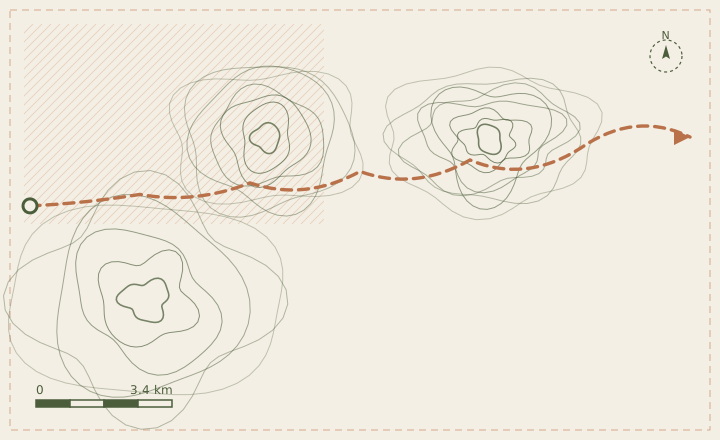
Vondelpark opened in 1865 and was the first public park in the Netherlands. It is 47 hectares, laid out in the English landscape style but with Dutch drainage. The Singelgracht path around the western water is about 3.4 km and is the calmest route through it, because it stays on the edge rather than crossing the middle.
Sight · Nineteenth-century park architecture in brick an… -
The park has one dominant hazard to a walking practice: bicycles. There are tens of thousands of cycle movements through it on a summer day. Walk this route with your attention genuinely on the path for the first ten minutes, and treat that as the practice rather than a preliminary to it. Awareness of moving objects is a legitimate form of mindfulness and a more useful one than most.
Sound · Bicycles, continuously and from all sides. Vonde… -
Start at the western entrance near the Amstelveenseweg and follow the water anticlockwise. The first section is asphalt with a clear camber, draining to both sides. This is the easiest ground on the route and a good place to settle into a six-count.
Touch · The main path is smooth asphalt, drained and cam… -
About a kilometre in, the path crosses the first of the brick bridges. Stop on the bridge for fifteen breaths. The bridge is a single arch over about eight metres of water, and it is one of the few places in the park where you are above the level of the crowd and can see a hundred metres in two directions.
Smell · Damp brick and duckweed along the water, cut gra… -
The middle section runs through the open grass, which is where the park is loudest, busiest and most likely to test a slow pace. Do not fight it. Walk at the pace of the people around you and keep the attention on the breath rather than the stride. Pace and attention are separable, and this is the place to find that out.
Breath · Flat and paved, so a six-count works throughout;… -
The last kilometre returns through the rose garden and the bandstand. In summer there are open-air performances on Friday evenings, which change the park entirely. If you are there on such an evening, walk the rose garden instead of the water and let the music be background rather than the object.
Sight · Nineteenth-century park architecture in brick an… -
Leave by the Van Baerlestraat side, where the park meets the museum quarter. The transition from 47 hectares of trees to the Stedelijk's white walls in under 200 m is abrupt, and it is worth standing at the edge for a moment to notice that you have been somewhere else.
Sound · Bicycles, continuously and from all sides. Vonde…
Before you walk
General wellbeing information, not medical advice. Vondelpark's paths are shared with a heavy and sometimes fast cycle flow; keep right, do not stop abruptly in the middle of a path, and take particular care at the blind approaches to the brick bridges.
Walking guidance on this site is general wellbeing information. It is not medical advice and it does not replace a clinician.