Redwood Cathedral Loop — Stout Grove
Jedediah Smith Redwoods State Park, California, United States
About this route
When to walk it
Open all year. The grove floods in winter, when the loop's low section holds standing water and the summer footbridges come into their own. June mornings are the best light — fog burns off by ten and the grove is dim again.
Numbers are estimates for the pace named above; the ground decides the rest.
Sensory anchors
Five things this ground gives you to notice. Each script paragraph ends on one of them.
- Sight Trunks three to five metres across, and no visible tapering until well above head height; the first branches begin forty metres up, so the eye finds no normal tree shape to anchor on.
- Sound The grove is quieter than the road 400 m away. Needles and fern absorb the middle frequencies, so a car passing sounds like a door closing in another room.
- Touch Redwood bark is fibrous and spongy, not hard — press a thumb in and it gives two or three millimetres. It is also damp under the ridges even in August.
- Smell Warm resin and cool fern at the same time; the two alternate as you move in and out of the sun patches, which is the clearest smell change on the route.
- Breath The scale pulls the breath long without effort: five paces in, seven out. Keep the exhale longer than the inhale for the whole loop.
Walking script
Choose a script
-
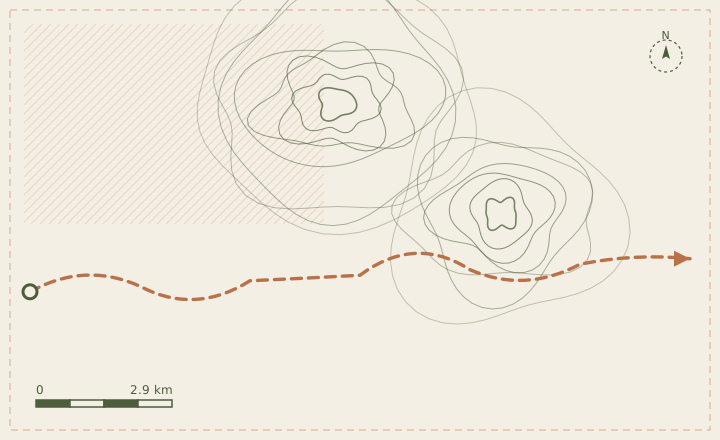
The Stout Grove loop is 2.9 km and takes about seventy minutes at a slow pace, which is longer than the distance suggests. That is deliberate: on ground this soft with trees this large, the useful pace is slower than a normal walk, and the loop is short enough that you never feel behind.
Sight · Trunks three to five metres across, and no visib… -
Begin by establishing where your eyes go. Most people spend the first five minutes looking up, which throws off the balance and shortens the stride. Look at the level of your own feet for the first hundred metres; the trunks are wide enough that they still dominate the edge of vision without you having to lift your head.
Sound · The grove is quieter than the road 400 m away. N… -
Around 700 m in there is a cluster of three trunks growing from what was once a single tree. It is the widest single object on the route. Stop for ten breaths and put a hand on one of the three. Redwood bark is spongy; a palm flat on it at chest height is the most useful touch contact on this walk.
Touch · Redwood bark is fibrous and spongy, not hard — p… -
The middle section crosses ferns on a flat bench. Walk it with a long exhale — five paces in, seven out. Fern and needle litter here is deeper than it looks; the ground gives several centimetres underfoot, and matching the breath to that slow, sinking rhythm is easier than imposing a count.
Smell · Warm resin and cool fern at the same time; the t… -
Near 2 km the loop drops into the low, wet part of the grove. In winter this is standing water and the route detours over the bridges. Either way, this is the darkest and the quietest section — the place where the traffic 400 m away stops being audible at all. Walk it without any instruction at all.
Breath · The scale pulls the breath long without effort: … -
The final 400 m climbs gently back to the trailhead. Keep the pace you had in the middle rather than speeding up to finish. The end of a loop walk is where most of the practice is lost, because the car becomes visible before the walk is over.
Sight · Trunks three to five metres across, and no visib… -
Finish by sitting on the bench at the trailhead for the length of one full slow breath cycle repeated twelve times. Redwoods here are between 300 and 900 years old, and the loop is under three kilometres. That mismatch is worth a minute of sitting still.
Sound · The grove is quieter than the road 400 m away. N…
Before you walk
General wellbeing information, not medical advice. Root plates here are hidden by fern and are easy to trip on; stay on the marked loop, and do not step off the boardwalks in the wet section in winter. Fog on US-199 near the park entrance can reduce visibility sharply.
Walking guidance on this site is general wellbeing information. It is not medical advice and it does not replace a clinician.