Seoul Bukchon Alleys — Between Two Palaces
Bukchon, Jongno District, Seoul, South Korea
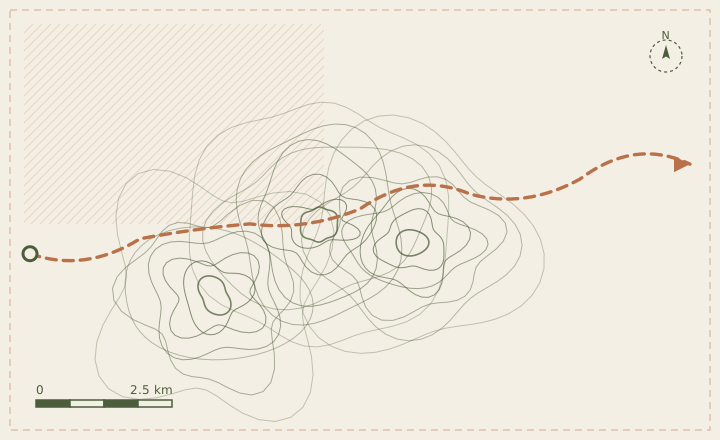
About this route
When to walk it
The alleys are at their best in the second half of October and the first week of November, when the ginkgos turn and the air is dry. April is the other good window. July and August are hot and wet, and the alleys have almost no shade.
Numbers are estimates for the pace named above; the ground decides the rest.
Sensory anchors
Five things this ground gives you to notice. Each script paragraph ends on one of them.
- Sight Hanok roofs of dark grey tile with upturned eaves, packed densely along lanes barely wide enough for two people; the palace wall across the main road is unbroken for 1.4 km.
- Sound Tile roofs and narrow walls make the alleys acoustically tight; a door closing two lanes away is audible. Main-road traffic is a constant background from any east-west lane.
- Touch Concrete and stone paving, with the stone kerbs worn smooth; many of the alleys climb as steps rather than ramps, with each step about 15 cm.
- Smell Soybean paste and garlic from kitchens at mealtimes, and in autumn the specific smell of ginkgo fruit, which is strong and unpleasant and most people notice before they identify it.
- Breath Seventy metres of climb in 2.5 km, in short steps. Four paces in and six out on the step sections; six and six on the palace road.
Walking script
Choose a script
-
Bukchon sits between two palaces — Gyeongbokgung to the west and Changdeokgung to the east — on the slope that the officials and relatives of the Joseon court built their houses on. The alleys are the residual space between those houses, which is why they are irregular and why they climb.
Sight · Hanok roofs of dark grey tile with upturned eave… -
This is a residential neighbourhood, not a museum, and about 900 people live in the hanoks here. That fact should shape the walk before it starts: walk quietly, do not photograph doorways with people behind them, and treat every lane as somebody's street rather than a set.
Sound · Tile roofs and narrow walls make the alleys acou… -
Start on the main road below the palace wall and walk east. The wall runs unbroken for about 1.4 km with a mountain behind it, which is the only long sightline on the route. Use it to set the pace before you go up into the alleys, where nothing is straight.
Touch · Concrete and stone paving, with the stone kerbs … -
The first alley climbs as steps rather than a slope — about 70 m of gain over the route, mostly in three sections. Korean traditional house plots were laid out to face south, so the lanes that separate them run up the fall line. Four paces in, six out, and stop at the top of each flight.
Smell · Soybean paste and garlic from kitchens at mealti… -
Halfway up, several alleys converge on a small open point where you can see the roofs of the whole quarter in one direction and the modern city in the other. Stand there for a full minute. The contrast is the whole content of this walk: 600-year-old roof forms occupying the same frame as a city of ten million.
Breath · Seventy metres of climb in 2.5 km, in short step… -
The upper alleys are the quietest and the narrowest — some barely a metre between walls. Walk these with your attention on the ground. They have steps, occasional cars using them as access, and residents coming and going with shopping. In a one-metre lane there is no such thing as a private walk.
Sight · Hanok roofs of dark grey tile with upturned eave… -
Finish by descending to Changdeokgung's wall on the east side rather than returning the way you came. The palace has a secret garden behind it that requires a separate timed ticket, and walking its perimeter wall for five minutes without going in is a reasonable way to end a walk that is entirely about the edge of things.
Sound · Tile roofs and narrow walls make the alleys acou…
Before you walk
General wellbeing information, not medical advice. Bukchon is a lived-in residential area with published quiet hours and signage against photography and noise in several lanes; residents have priority on the steps. The alleys are narrow enough that a car using one has nowhere to pass a pedestrian — stand aside at a doorway.
Walking guidance on this site is general wellbeing information. It is not medical advice and it does not replace a clinician.