Bois de Vincennes — Lac Daumesnil Circuit
Bois de Vincennes, 12th arrondissement, Paris, France
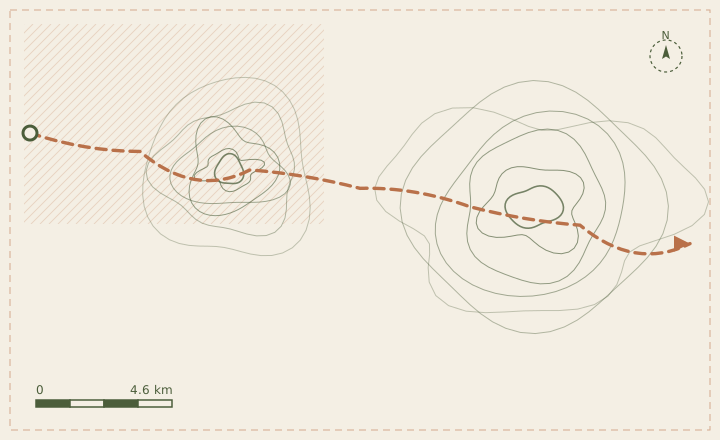
About this route
When to walk it
Walkable all year and best in May and October. The wood is 995 hectares — larger than the whole of central Paris's first four arrondissements — and it is noticeably quieter on weekday mornings than the Bois de Boulogne on the other side of the city.
Numbers are estimates for the pace named above; the ground decides the rest.
Sensory anchors
Five things this ground gives you to notice. Each script paragraph ends on one of them.
- Sight Two islands in the lake connected by a spillway, with a temple-like folly on the larger one; herons stand on the spillway wall at almost any hour.
- Sound Waterfowl, not traffic, dominate here — the Péripherique is beyond the eastern edge and the wood absorbs it. Ducks and coots argue continuously at the lake's south end.
- Touch The circuit path is compacted earth with gravel sections; the lake edge is mud and reed, soft enough to leave clear footprints.
- Smell In warm weather the lake has a real reed-and-silt smell at the southern end, which is the least manicured part of the circuit.
- Breath The circuit is nearly flat. Use a long count — eight paces in, eight out — and let it be the whole instruction for the first half.
Walking script
Choose a script
-
The Lac Daumesnil circuit is about 4.6 km on the path that runs around the water and crosses the spillway between the islands. Enter from the Porte de Saint-Mandé and go anticlockwise so that the sun is behind you in the morning and the lake surface is lit.
Sight · Two islands in the lake connected by a spillway,… -
This was a hunting forest for the French crown and was redesigned under Napoleon III by Adolphe Alphand into the English-style landscape you walk through now. That history matters for pacing: Alphand's paths are laid out in long curves that are designed to hide their own length, so the circuit feels shorter than 4.6 km. Watch for the moment you think you are nearly finished and are not.
Sound · Waterfowl, not traffic, dominate here — the Péri… -
The lake supports a large and self-sustaining waterfowl population. There are herons on the spillway, cormorants on the island trees and a permanent argument of ducks at the southern end. For the first kilometre, walk and listen to nothing but the birds. Waterfowl calls are irregular and unpredictable, which makes them difficult to use as a rhythm and good for practising an unanchored attention.
Touch · The circuit path is compacted earth with gravel … -
Cross the spillway slowly and stop in the middle. The two islands are connected here and the depth on both sides is under a metre. Standing on a narrow strip of stone between two bodies of water is a physical change of state worth twenty breaths.
Smell · In warm weather the lake has a real reed-and-sil… -
After the islands the path runs along the eastern shore and passes the restaurant that has been on the lake since the 1860s. It is the busiest point of the circuit. Walk past it at a sustained pace rather than stopping; a stop here tends to end the walk earlier than intended.
Breath · The circuit is nearly flat. Use a long count — e… -
The southern kilometre is the wildest. Reed beds, mud, and a path that is narrower and less maintained. This is the best place on the route to walk at the slowest pace you can hold without stopping. Let the ground set the speed.
Sight · Two islands in the lake connected by a spillway,… -
Finish back at the Porte de Saint-Mandé. Opposite the entrance is the Château de Vincennes, whose keep is 52 m tall and is the tallest medieval fortified tower in Europe. Looking up at it from ground level after an hour of looking at water is a useful way to end.
Sound · Waterfowl, not traffic, dominate here — the Péri…
Before you walk
General wellbeing information, not medical advice. Parts of the wood are unlit and the park has a stated closing time that is enforced; check the gate times on the way in. The lake edges are mud and can be undercut — keep back from the water line.
Walking guidance on this site is general wellbeing information. It is not medical advice and it does not replace a clinician.