Bialowieza Forest — Strict Reserve Buffer Path
Bialowieza National Park, Podlaskie, Poland
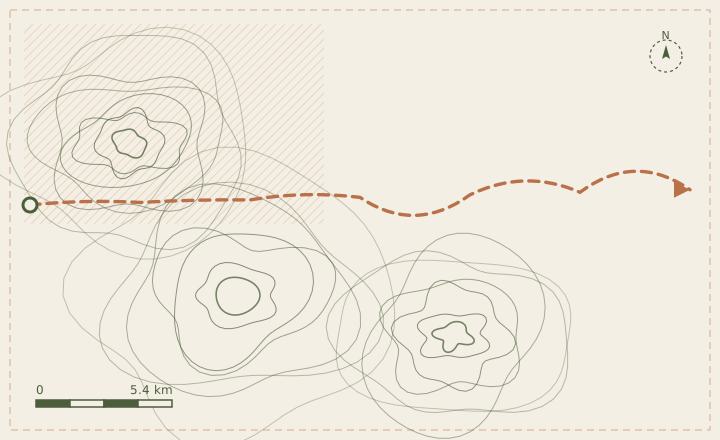
About this route
When to walk it
Access to the inner reserve is by licensed guide only, and the buffer path is the part you can walk on your own. Mid-May is the loudest fortnight of the year — dawn chorus with more than 120 breeding bird species recorded in the park. Mosquitoes from June to August are severe enough to change how you walk.
Numbers are estimates for the pace named above; the ground decides the rest.
Sensory anchors
Five things this ground gives you to notice. Each script paragraph ends on one of them.
- Sight Dead trunks standing forty metres tall and striped with bracket fungus; nothing is cleared here, so the middle distance is full of fallen giants at every angle.
- Sound At dusk in May, three or four species overlap in the same ten seconds; by day, the loudest thing is often a woodpecker working dead wood, which sounds like a hammer on a hollow post.
- Touch The forest floor is deep with soft litter and holds water after rain. It is springy, uneven, and gives more than you expect on every step.
- Smell Fungal, sweet and woody at once, strongest where a trunk has been down for a year or two. It is not a fresh-forest smell; it is a rot smell, and it is the point of the place.
- Breath This is flat ground, so the count can be very long: ten paces in, ten out. Let the pace come down until the count is comfortable.
Walking script
Choose a script
-
This is a route for walking slowly in a place where walking slowly is the only sensible option. The buffer path is 5.4 km, almost perfectly flat, and the ground is soft enough that shoes are quiet. Start by letting your stride shorten on its own — soft ground does most of that work for you.
Sight · Dead trunks standing forty metres tall and strip… -
The dominant fact of Bialowieza is dead wood. Around a quarter of the standing volume in the reserve is dead, and none of it is removed. Walk the first kilometre counting the fallen trunks you pass. Most people stop counting when they lose track around fifteen, which is itself the lesson.
Sound · At dusk in May, three or four species overlap in… -
Between kilometres one and two the path passes a stand of very old oaks. Stop and look up rather than straight ahead. The crowns here are above the surrounding canopy line, and looking up is the only way to see that the forest has more than one storey.
Touch · The forest floor is deep with soft litter and ho… -
Birdsong is continuous from April to June but the density is easy to over-listen for. Pick one call and follow it rather than trying to identify everything at once. Two minutes on a single voice does more for attention than an hour of scanning.
Smell · Fungal, sweet and woody at once, strongest where… -
The middle section opens onto wet meadow. Expect mosquitoes in summer; walk through this stretch at a slightly quicker pace and save the slow walking for the wooded sections. Adjusting pace to terrain is not a failure of the practice — it is the practice.
Breath · This is flat ground, so the count can be very lo… -
About 4 km in there is a bench at the boundary of the strict reserve. Strictly, you may not pass it without a guide. Use the stop well: sit, drink, and let the forest be loud around you without you contributing anything to it.
Sight · Dead trunks standing forty metres tall and strip… -
The return leg is the same path in the same direction of light if you started in the afternoon, which makes it easy to stop noticing. Give yourself an instruction for the way back: no counting, no breath control — just walk and notice when the ground changes from litter to grass and back.
Sound · At dusk in May, three or four species overlap in…
Before you walk
General wellbeing information, not medical advice. The strict reserve requires a licensed guide and a permit; walking past the boundary marker without one is an offence. Summer mosquitoes here are exceptional — long sleeves and repellent are practical necessities, not precautions.
Walking guidance on this site is general wellbeing information. It is not medical advice and it does not replace a clinician.