River Avon — Christchurch Punting Path
Christchurch, Canterbury, New Zealand
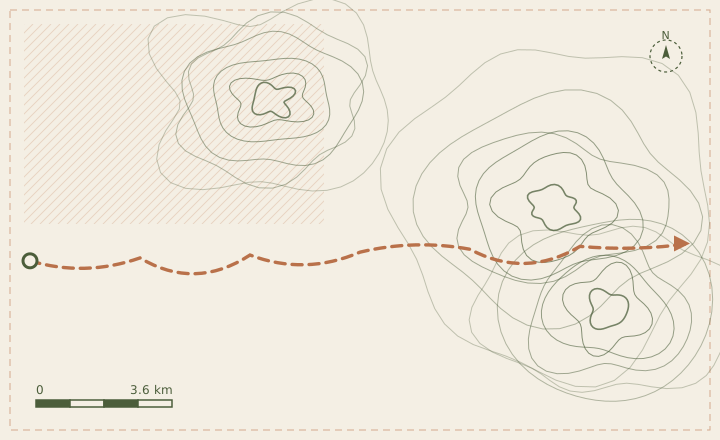
About this route
When to walk it
The Avon is spring-fed and flows at 10-14 °C all year, so the path beside it is noticeably cooler than the city in summer. October to April is the walking season; the willows are at their fullest in December and the path is busiest then too.
Numbers are estimates for the pace named above; the ground decides the rest.
Sensory anchors
Five things this ground gives you to notice. Each script paragraph ends on one of them.
- Sight Water clear enough to see the gravel bed three metres down, and punts moving at walking speed with a person standing at the stern.
- Sound The punt pole entering and leaving the water — a hollow, precise knock — is the signature sound of this route, repeating every three or four seconds from each boat.
- Touch The path is fine gravel, well drained, with wooden edging near the banks; the willows overhanging the water have bark that is rough and dark and holds moisture.
- Smell Cold spring water and duckweed; on warm days the riverbank has a faint green, slightly sweet smell from the weed growing on the bed.
- Breath Almost no gradient, so a six-count throughout; the two footbridges take a four-count on the ramps.
Walking script
Choose a script
-
The Avon runs about 14 km through Christchurch and the central stretch between the Antigua Boatsheds and the Botanic Garden is the part with a path on both banks. This route walks 3.6 km of it, crossing twice so that you spend time on both sides.
Sight · Water clear enough to see the gravel bed three m… -
The defining feature of this river is that it is spring-fed: it comes out of the ground at a constant 10-14 °C, which means it is cold in summer and warm in winter relative to the air. Put a hand in it at the start. The temperature is the fact that explains everything else — the clear water, the weed, the mist on winter mornings.
Sound · The punt pole entering and leaving the water — a… -
Start at the Antigua Boatsheds, which have been hiring punts here since 1885. Watch one leave. A punt has no engine and no oars; it is pushed by a person standing at the back using a pole against the bed. That means it moves at the speed of a slow human and makes a sound you can follow with your ears alone.
Touch · The path is fine gravel, well drained, with wood… -
Walk the north bank first, upstream. The path here is under willows for most of a kilometre and the light comes through in patches. Use the patches as a rhythm: walk and count the number of light patches you pass. It is a soft count, which is a useful alternative when a fixed number starts to feel mechanical.
Smell · Cold spring water and duckweed; on warm days the… -
Cross at the Montreal Street bridge and return downstream on the south bank. From this side you look towards the city rather than away from it, and the punts come towards you instead of away. Reversing the direction of travel is the cheapest way to change what a walk is about.
Breath · Almost no gradient, so a six-count throughout; t… -
The last section passes the Botanic Garden, where the path widens and the grass comes down to the water. This is the busiest part. Slow down rather than speeding up — the instinct at the end of a walk is to accelerate, and here the surroundings reward the opposite.
Sight · Water clear enough to see the gravel bed three m… -
Finish at the Antigua Boatsheds. In winter, mist sits on the river until about ten in the morning because the water is warmer than the air, and the punts appear out of it one at a time. Watching water that behaves differently from the weather around it is a good note to end a walk on.
Sound · The punt pole entering and leaving the water — a…
Before you walk
General wellbeing information, not medical advice. The Avon is a spring-fed river with undercut banks and cold water year-round; it is not a swimming river inside the city and the banks are steep in places. The path is shared with cyclists and, in summer, with large numbers of visitors.
Walking guidance on this site is general wellbeing information. It is not medical advice and it does not replace a clinician.